
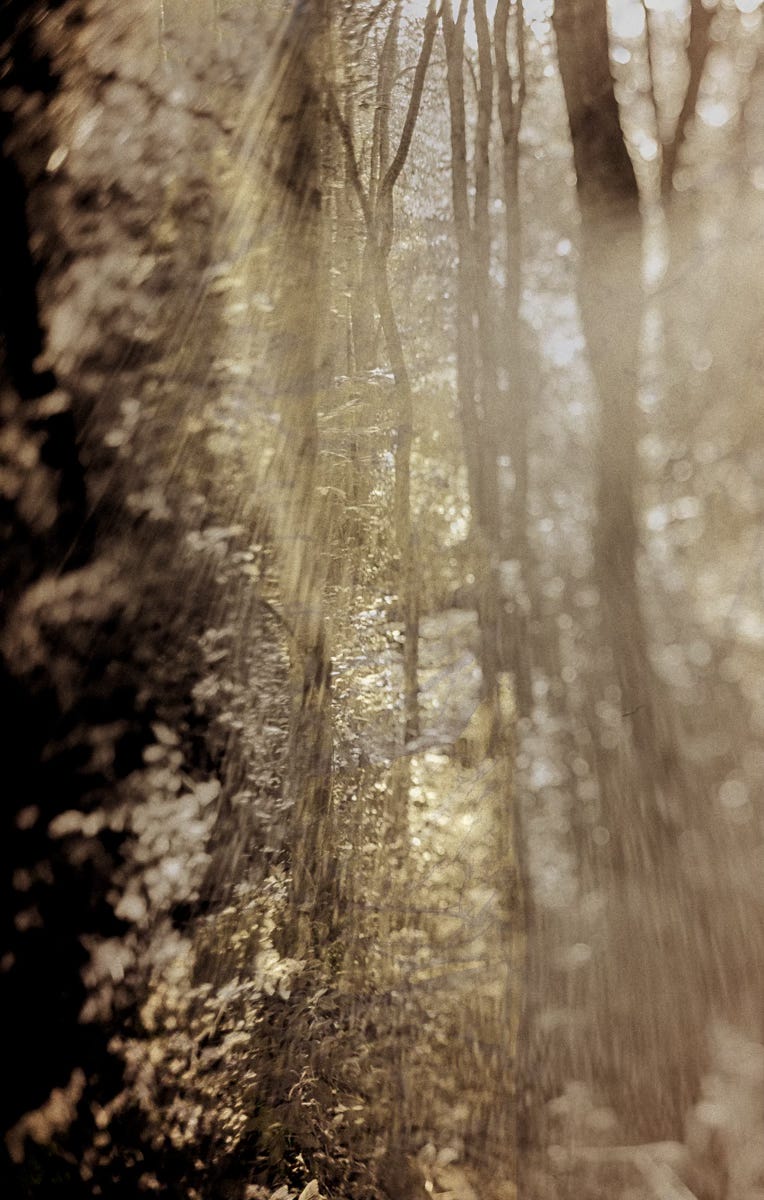
“A resonance emerges instantly from the wild world. It is a homecoming—an exchange buried deep in our cells. We recognize it at once,
as we know and are known.”
Karen Olson - Cultivating the Heart Sense
It was exactly one year ago today. I arrived at Macaw Lodge in Turrubares, Costa Rica, for a Forest Therapy Immersion. I attempted to find my bearings after the long, winding ascent up the mountain through washed-out ruts of red clay and cliffside hairpin vistas.
And yet, as we approached this isolated retreat center—nestled within a 12-acre botanical garden, surrounded by jungle paths and pristine waterfalls—I felt immediately at home.
My shared room was one of eight at the top of a spiral staircase. It overlooked a stream-like canal that flowed into a deep, acre-wide pond just outside the dining hall. A huge screen spanned one entire wall of the room—no glass, no enclosure—just floor-to-ceiling mesh connecting us to the outside world.
It was about 5 p.m., and the wildlife in the pond was actively pursuing dinner. Toads, frogs, birds, insects, and lizards joined in the symphony.
It was the cicadas that led the chorus. Their song was almost deafening—whirring, buzzing, clicking—a steady vibration rising from the air itself. Their call has been described as a cyclical rising-and-falling crescendo that feels tidal. I completely agree.
One might think such a high-pitched, extremely loud sound would drive a person crazy. But the opposite was true.
My nervous system had been running hot for months—truthfully, for years. But here, in this moment, I could feel it ratcheting down toward baseline. And it stayed there the entire week.
The rhythms and wave-like song of this small but powerful creature created a coherence between my heart rhythm and the rhythm of the jungle. An experience I will never forget.
What Is Resonance?
When something resonates, you feel it immediately. The nervous system feels met by someone or something. It might arise from the more-than-human world, a conversation, a concept, or even a warm and genuine smile.
We are constantly entraining to the world around us. When two systems interact, they can begin to match tempo or pattern. Two hearts can entrain. Our unique system can match step with another unique system. When this happens, all feels right with the world. We experience coherence.
I have recently been introduced to the idea of a baseline—or set point—in the nervous system. In a dysregulated state, the nervous system can run too hot or too cold. When either state becomes our norm for months or years, it can contribute to illness. This is because the nervous system is intimately connected to other systems in the body—cardiovascular, musculoskeletal, immune, and endocrine. The endocrine system in particular shapes how pain is perceived and influences nerve sensitivity and stress response.
No system in the body exists in isolation. It is all connected.
I quote:
“The remarkable thing about this set point is that it’s calibrated to meet our true needs (i.e. the needs of our lived reality). Unfortunately, factors such as illness, trauma and chronic stress can swing us away from this set point, and even change it entirely. If we exist in a hot or cold state for long enough for our brain to perceive it as our new reality, our set point will recalibrate to meet what it believes to
be our true needs.”
Jessica Maguire - The Nervous System Reset
It works both ways. Stressors can pull our nervous system away from baseline and contribute to illness. Illness itself can further shift our set point, creating a feedback loop.
At baseline we are not numb, nor hyper-alert. We are in a state of responsive presence—ready to meet the shifting demands of the day.
Running hot—hyper-alert, hyper-vigilant—is where I personally get stuck. My experience in the Costa Rican jungle showed me just how profoundly environment influences this state. It also set me on a path of inquiry.
If environment can dysregulate us, can it also regulate us? Can we craft environments that support our return to baseline?
The answer is yes. But we must seek this out. Leaving regulation to chance encounters or epic vacations is not enough.
“Strengthen the neural pathways for positive sensations by seeking out things that feel good. What you look for, you get more of… Let’s start scanning for pleasant sensations in the body throughout the day.”
Emma McAdam
And so I began to notice.
Four Doorways to Resonance
Sound
As the jungle illustrated so clearly, sound is one of the most accessible pathways to resonance. It is inexpensive, universally available, and an amazing potential for profound joy. It may be as simple as stepping outside to listen to birdsong, or as involved as learning an instrument.
What makes an experience resonate is not the sound itself, but how our body responds to it.
As a forest therapy guide, I offer this invitation that can be responded to while in the forest, a green space, or in your home:
Giving attention to your sense of hearing,
I wonder, what is the quietest sound you can hear.
I wonder if there is a melody to this place.
Is there a rhythm in the sounds around you?
I wonder if you can connect your inner rhythms with the rhythms of this place.
Perhaps you would like to add your own sound to this place—just loud enough so only you can hear it.
I might add, if you are in a place where you can vocalize more freely, sounding loudly can be cathartic—something we rarely allow ourselves to do.
Begin noticing sounds on a daily basis. Which sounds resonate with you. Make a list. These are materials—tools—you can return to when you need to find your set point again.
Rhythm
Rhythms—wave-like patterns—are everywhere. Music is a beautiful and immediate way to introduce rhythm. It can match our mood or gently shift it.
We can also create rhythm ourselves: tapping fingers, swaying, swinging arms, walking, knitting, stitching, folding paper. When you do these things, you are not just “doing something with your body.” You are giving your nervous system a predictable pattern to follow.
The heart is one of our primary rhythm-makers—an organ of sound and movement, intimately tied to breath and life.
I offer this invitation:
Make a fist with your hand, bringing that fist to the center of your chest and resting your closed fist in the center of your chest.
You might feel the sensation of your own beating heart.
What does the rhythm of your heart feel like?
What is your heart sensing right now?
What might your heart be reaching toward?
Movement
Moving too fast, trying to accomplish too much, stretching beyond my capacity—that is where I get into trouble. Intentional movement, however, is my grounding.
I can confuse hyperfocus with intentionality. They are not the same.
This awareness is ongoing work. I try to check in daily.
A combination of rhythm and movement supports proprioception—our sense of where we are in space—and interoception—our awareness of the internal state of the body. When both inner and outer sensing come online together, I return to equilibrium.
What does this look like?
Walking forward slowly and rhythmically, noticing hip alignment, the distance between my feet, the shifting of balance.
Walking backward—safely and slowly—placing one foot behind the other, torso aligned.
Swinging arms wide, overhead, behind me, reaching toward the ground.
Not mere repetition as exercise, but movement infused with awareness.
You also might try a slow wander for five to ten minutes. Notice what it feels like to move slowly. As you move, notice what is moving. Let your body recalibrate through deliberate motion.
Repetition
Creative repetition is especially helpful in the evenings or during difficult seasons.
I suggest having three types of creative engagement available:
A project requiring focus, innovation, and discovery.
A project building on those discoveries without requiring new invention.
A repetitive process—something you can do without much cognitive strain but that remains satisfying.
This third engagement might be stitching, sanding, simple paper preparation, light editing, organizing files, or planning. It may even be something unrelated to your primary body of work.
For me, repetitive process puts everything in a row. It packs the day up gently and puts the cares of the world to bed.
We are electrical beings—voltage moving through tissue, rhythm pulsing through muscle. When we find or make sounds, rhythms, movements, and repetitions that meet us and support us, we recalibrate. We remember our original tuning.
Resonance is something we can choose to notice and invite.
Perhaps the work is not to control the nervous system, but to surround it with patterns that allow it to settle. To listen for what feels like home. To cultivate the conditions where heart and world can match tempo again.
And then, gently, to stay in relationship with that song.
Our March salon-style meetup for community members will center around the idea of finding what resonates. Please consider subscribing as a supporting member. Our next Rivers Speak in Voltage meetup will be on March 26 at 1 pm EST. Won’t you join us?
Beautiful 💚 thank you for sharing!
I like the sounds of creating environment that resonates and that the nervous system welcomes calibration to. Enjoying a baseline nervous system rhythm. Thank you for sharing projects and idea to embrace a supportive environment! Love it!